
Common takeaway packaging types include bagasse clamshells, kraft folded boxes, paper bowls, aluminium trays and clear plastic containers. Choose by food, usable size, closure and destination requirements, then test the complete pack with the intended meal.
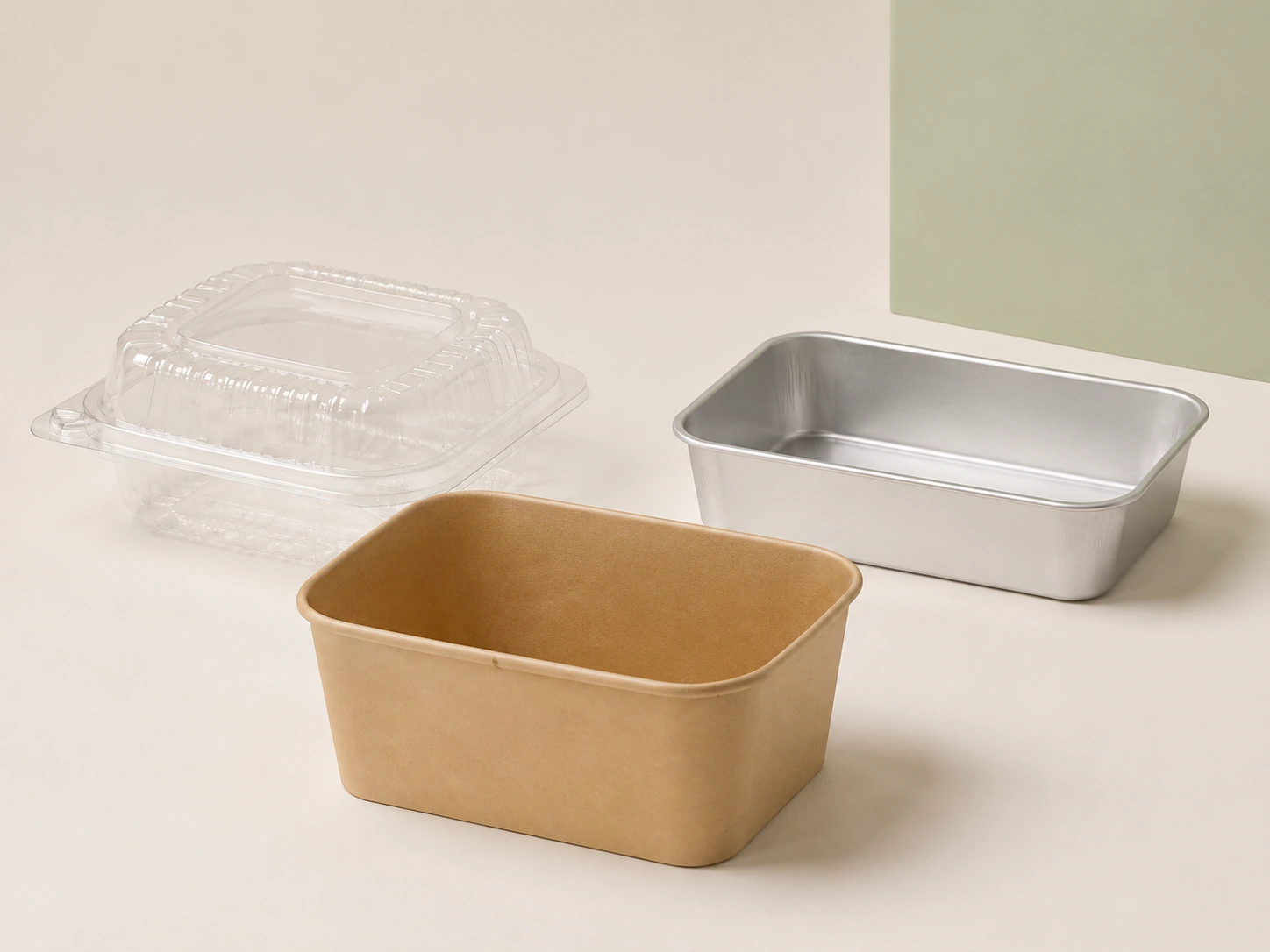
| Format | Useful starting brief | What to confirm |
|---|---|---|
| Bagasse clamshell | Single-pack meals or compartment portions | Fibre construction, coatings, holding time and closure |
| Kraft folded box | Folded takeaway packs with optional print | Lining, food contact, dimensions and folding workflow |
| Paper / kraft bowl | Portioned meals with a separate lid | Usable capacity, lining and exact lid reference |
| Aluminium tray | Prepared-food and tray-based briefs | Coating, lid, food and heating instructions |
| Clear PET / PP container | Product visibility and portion presentation | Exact polymer, intended temperature and market restrictions |
Map the food and portion first.
Record food type, portion weight or volume, shape, sauce or moisture context and the desired presentation. Add required headspace and whether components must remain separated.
Use these inputs to shortlist usable geometry rather than starting from a familiar product photograph.
- Food and portion
- Usable dimensions
- Headspace
- Compartments
- Presentation
Describe the service journey.
State filling condition, holding interval, storage, transport orientation and expected consumer use. Identify reheating, chilling or display requirements that need model-specific confirmation.
A material label alone is not evidence that a format suits every temperature or use condition.
Select material in context.
Compare material together with construction, closure, clarity, stiffness, weight and available documentation. Keep environmental claims separate unless evidence and the destination's recovery context support them.
Ask for the selected model's intended use and supporting records to be confirmed.
Compare catalogue products by material · Alternatives and plastic restrictions
Treat the closure as part of the product.
Identify hinged, folded, separate-lid or sealing requirements. Record a separate lid with its base, and review closing, opening, stacking and transport with the actual components.
Similar-looking rims or covers should not be treated as interchangeable without confirmation.
Compare hinged and folded formats
Test workflow and packing.
Fill, close, hold, stack and transport representative samples using the real service routine. Include line-side storage and outer-case handling when they affect operations.
Record sample identity and conditions so the result can be connected to the quoted model.
Compare commercial terms last.
Once the candidate specification is stable, request MOQ, price, packing, lead time, sample status and documents on the same basis. Convert quantities into complete cases and matched components.
Use a written RFQ to separate confirmed facts from options and open questions.
Build the complete RFQ · Discuss a custom project
Questions before quotation
What should be chosen first: material or container shape?
Begin with food, portion and service conditions, then compare geometry, material and closure together against those requirements.
Is nominal capacity enough to select a container?
No. Add usable dimensions, portion shape, headspace, compartments, closure and the complete service journey.
When should price be compared?
Compare price after each supplier is quoting the same model-level specification, quantity unit, packing, document scope and delivery basis.
Continue your buying brief
Takeaway boxes and containers · Container size guide · Food packaging RFQ checklist