
Hinged and folded containers solve different operating problems. Compare them through the food, filling routine, closure, transport, storage and branding requirements—not by shape or material name alone.
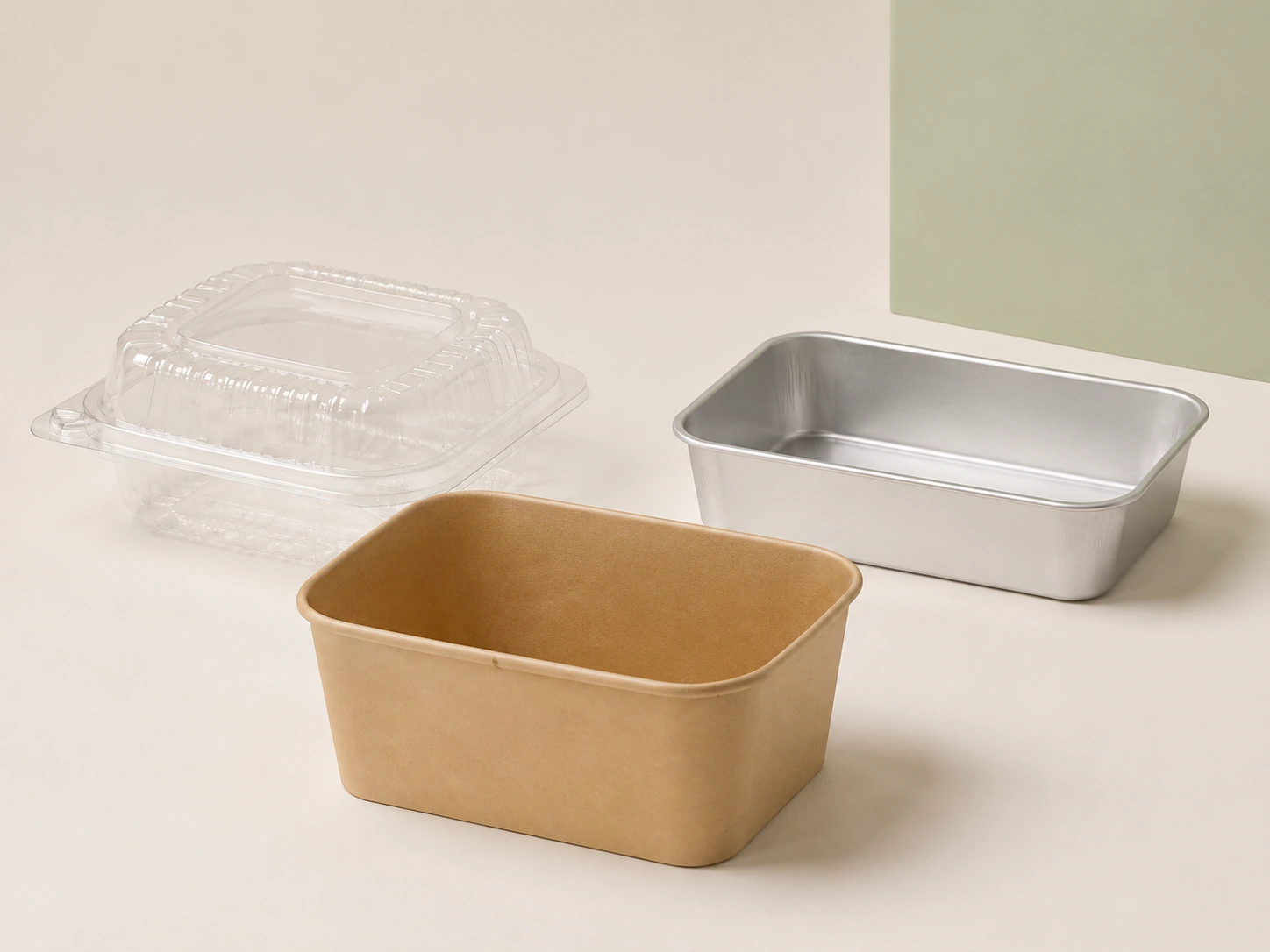
What is the practical difference?
A hinged container joins the lid and base in one construction. A folded container is formed through panels and closure tabs; other ranges may use a separate lid. That structural difference affects assembly, storage and the closing routine.
Do not assume one format is universally better. Shortlist the exact models and test them with the intended food and service conditions.
Browse takeaway container families
Compare food fit and usable geometry.
Record the portion shape, usable base area, internal height, headspace and compartment needs. Nominal capacity alone can hide differences between a broad shallow pack and a narrower deep one.
Check whether the food touches the closure area and whether the closed pack preserves the intended presentation under the normal fill level.
Review closing and transport.
Run the real closing action with trained and untrained operators, then stack and transport the filled pack in its expected orientation. Record opening, re-closing and any movement that matters to the application.
Closure performance is model- and condition-specific. Ask for intended-use suitability to be confirmed in writing.
Measure assembly and storage impact.
Compare how each format arrives, nests, unfolds and occupies the work area. Include pieces per sleeve, packs per case, case dimensions and gross weight in the operational review.
A compact shipping case may still require more assembly at the point of service. Buyers should evaluate both warehouse and line-side handling.
Define branding after the format.
A folded surface, hinged lid, label or sleeve can offer different artwork areas. Select the exact base model before finalizing print coverage, dielines or label position.
Decoration availability and setup conditions depend on the construction and project. Request the feasible route for the shortlisted model.
Prepare the customization brief
Make the final comparison auditable.
Place food fit, closure, workflow, packing, artwork, sample result, documents, MOQ, price and timing in one comparison table. Mark unconfirmed fields rather than filling them with assumptions.
The selected format should be identified by model and revision in the final written specification.
Use the complete RFQ checklist
Questions before quotation
Are folded containers always made from paper?
Do not infer material from the closure name. Confirm the exact construction and supporting specification for each model.
Is a hinged lid always more secure?
Not automatically. Closure behaviour depends on the exact design, fill, temperature, handling and transport conditions and should be tested by model.
Which format is easier to customize?
Available print, label or sleeve routes depend on the selected material, geometry, artwork and project scope. Confirm the feasible route after model selection.
Continue your buying brief
Takeaway boxes and containers · Custom takeaway containers · Food packaging RFQ checklist