
Prepared-food retail packaging must support both the product and the selling environment. A useful brief connects fill and storage conditions to presentation, closure, label space, shelf handling, case data and destination-market documentation.
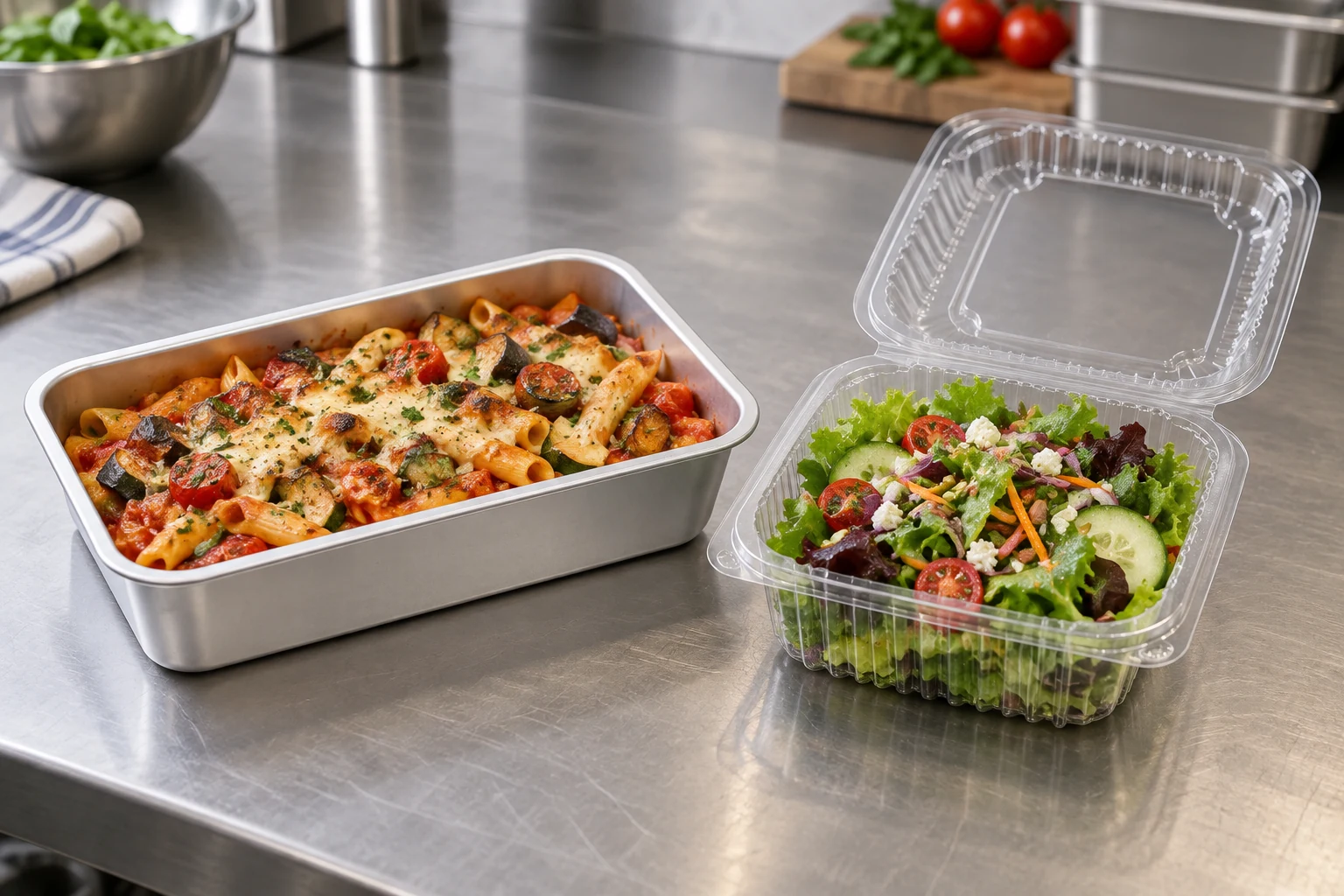
Define the product journey to the shelf.
Describe filling, closing, chilling or hot holding, transport, display orientation and expected consumer handling. State whether the pack is filled centrally or at store level.
These conditions should be reviewed for the exact model and material. Avoid turning a broad material label into an unsupported use claim.
- Food and portion
- Fill condition
- Storage and display
- Transport orientation
- Consumer opening
Browse takeaway container families
Balance visibility, structure and closure.
Identify how much product visibility is needed and whether the lid, base or window provides it. Compare usable shape, headspace, stack behaviour and closure rather than selecting by appearance alone.
If tamper evidence, film sealing or a separate lid is required, describe the intended system and request a model-specific review of the components involved.
Compare hinged and folded formats
Reserve space for retail information.
Map the label, sleeve, barcode, date code and product information area before artwork approval. Check how seams, curves, lids and stacking affect legibility and application.
The buyer remains responsible for market-specific text and claims. Keep the approved label or printed-artwork version connected to the exact packaging model.
Prepare a custom printing brief
Test merchandising and store handling.
Use filled samples to review shelf presentation, stacking, picking, closing and consumer opening under the intended conditions. Include outer cases and replenishment handling when they affect store operations.
Record test conditions and observations instead of treating one visual sample as universal evidence. Confirm what each sample represents before approval.
Quote every retail version clearly.
Separate quantities by model, size, colour, artwork, label or sleeve version. Ask for MOQ, price, packing, setup items and lead time on that same breakdown.
Request case dimensions and gross weight for warehouse and transport planning. Use confirmed case data for loading estimates rather than a generic category assumption.
Review MOQ inputs · Review packing and timing
Request evidence for the exact scope.
State the destination market, food-contact conditions and any retailer-specific document request. Review the product or material identity, scope, issuer and validity of available records.
Final suitability, documents, specification and commercial terms should be confirmed in writing before order release or a private-label claim is made.
Review quality and document handling · Use the supplier-verification guide · Build the RFQ
Questions before quotation
Which container is best for prepared-food retail?
There is no universal format. Select against the food, portion, fill and storage conditions, display needs, closure, label space and destination requirements.
Can transparent packaging be assumed suitable for hot filling?
No. Temperature suitability depends on the exact material, construction and conditions and must be confirmed for the selected model.
What case data should retail buyers request?
Request pieces per pack, packs per case, case dimensions, gross weight and any model-specific nesting or component information needed for storage and loading.
Continue your buying brief
Takeaway boxes and containers · How to choose takeaway packaging · Food packaging RFQ checklist