
Paper, PET and PP cups are not interchangeable category labels. The useful choice begins with the beverage and service journey, then compares the exact cup construction, rim and lid, presentation, decoration, packing and evidence required for the destination market.
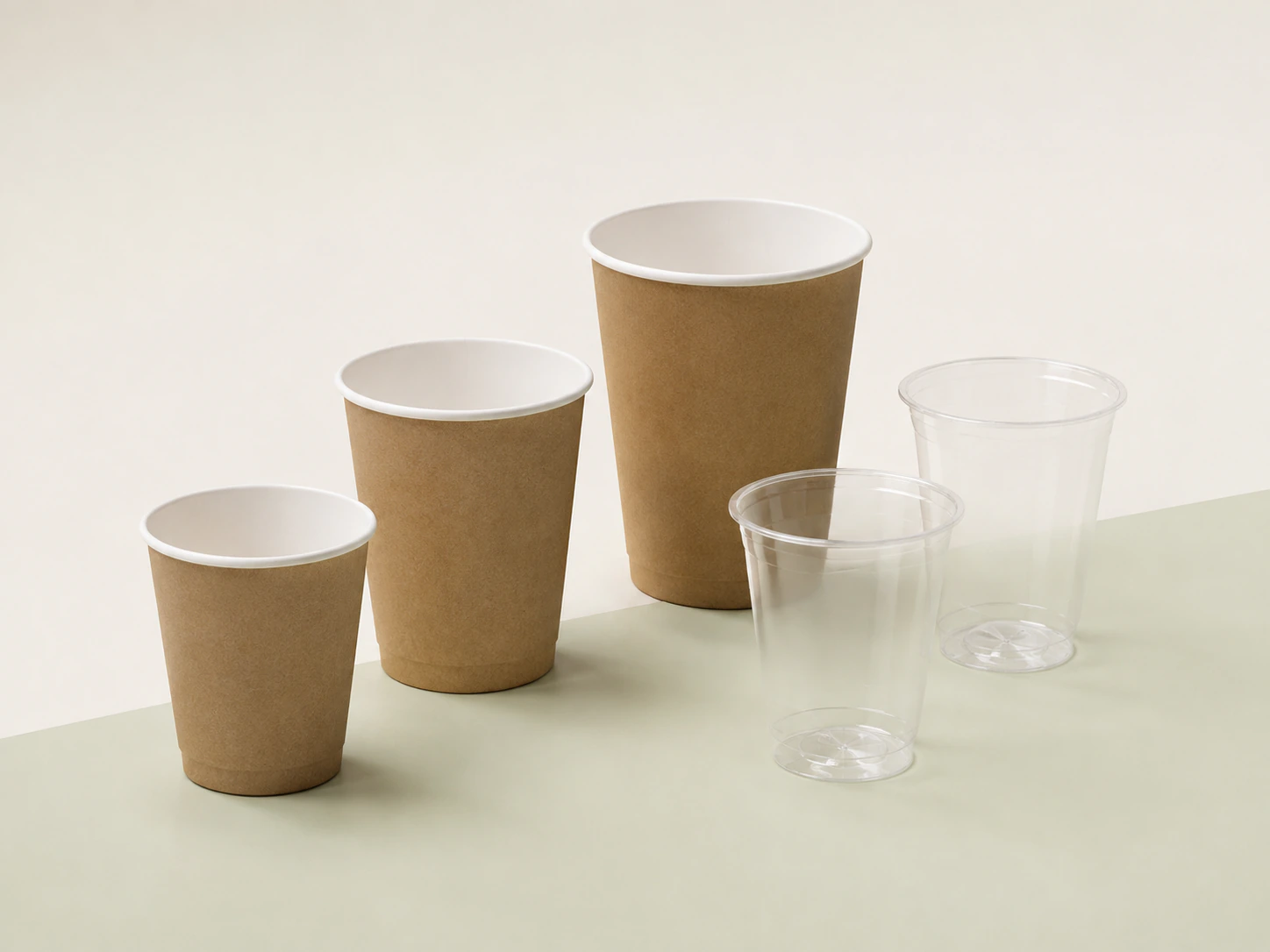
Start with the drink and service conditions.
Record the beverage, serving condition, expected hold interval, transport orientation and whether the cup will be used for counter service, delivery, sampling or prepared retail. These inputs determine which model-level questions need to be answered.
Do not translate a material name into a universal temperature or performance claim. Ask for the intended use to be reviewed against the exact cup, lid and operating conditions.
- Beverage and fill condition
- Serving and holding interval
- Delivery or counter service
- Required visibility
- Destination market
Use the disposable cup sourcing guide
Compare the current range by construction.
The current ANWELLUP catalogue separates single-wall and double-wall paper cups, PET cold cups, general PP disposable cups and tall PP milk-tea cups. That separation is more useful than a broad paper-versus-plastic label because each family has its own sizes, dimensions and specification status.
Use the family page and AW SKU to anchor the comparison. Any dimension, weight or pack field that is absent or marked for review should remain an open item in the RFQ.
Single-wall paper: Listed 8, 12, 16 and 22 oz references; selected entries show 1,000 pcs/ctn
Double-wall paper: Listed 8, 12 and 16 oz references; selected entries show 500 pcs/ctn
PET cold cups: Listed 7–10 oz references with model dimensions and 1,000-piece case entries
PP drinkware: General disposable references from 1–20 oz plus 500 ml and 700 ml milk-tea formats
Decide how visibility and presentation matter.
A clear cup may be relevant when the drink, colour, layers or inclusions are part of the presentation. Paper constructions may provide a different surface and visual language for coffee or branded beverage service. These are program requirements, not proof of technical suitability.
State whether clarity, cup colour, surface finish, condensation appearance or a sleeve is part of the brief. Review the filled product in the intended lighting and service context.
Treat the rim and lid as one system.
Nominal capacity does not confirm lid compatibility. Record the cup AW SKU, dimensions and matching lid reference together, then test closing, opening, stacking and transport with the exact components.
When several cup sizes are expected to share one lid, request a written compatibility matrix. Similar-looking rims should not be treated as interchangeable.
Build a cup-and-lid compatibility matrix
Compare decoration after the base cup.
Select the exact construction before approving a print area, dieline, sleeve or label. Record artwork versions, colours, coverage, print sides and any barcode or market-specific text separately.
Ask what the proof or sample represents. A layout proof, colour reference and production-representative sample can support different decisions and should not be described as equivalent.
Plan custom printed coffee cups · Structure cup printing samples
Close the comparison with commercial evidence.
Request MOQ, price, case pack, cup-and-lid order units, sample status, lead-time basis and available product records against the same written specification. Compare complete usable sets rather than cup piece prices alone.
The final choice should name the cup, lid, artwork, pack and intended use. Any performance, environmental or compliance statement should be checked against model-specific information and the destination context.
Review cup MOQ inputs · Plan cup packing and timing · Review quality and document handling
Questions before quotation
Are paper cups always for hot drinks and plastic cups for cold drinks?
Do not use that shortcut as a specification. State the beverage and service conditions, then confirm suitability for the exact cup construction and model.
Which cup material is easiest to custom print?
Decoration options depend on the selected cup construction, artwork, coverage and project scope. Choose the base cup first and request the feasible print or sleeve route for that model.
Can cups with the same ounce capacity use the same lid?
Not automatically. Compatibility depends on the exact rim and component design, so record and verify the cup-and-lid references together.
Continue your buying brief
Disposable cups and drinkware · Disposable cup sourcing guide · Food packaging material comparison · Food packaging RFQ checklist