
Bulk and individually wrapped cutlery solve different operational problems. The decision should follow the issuing routine, handling controls, kit completeness, branding, storage and total pack system—not a generic assumption that one format is always better.
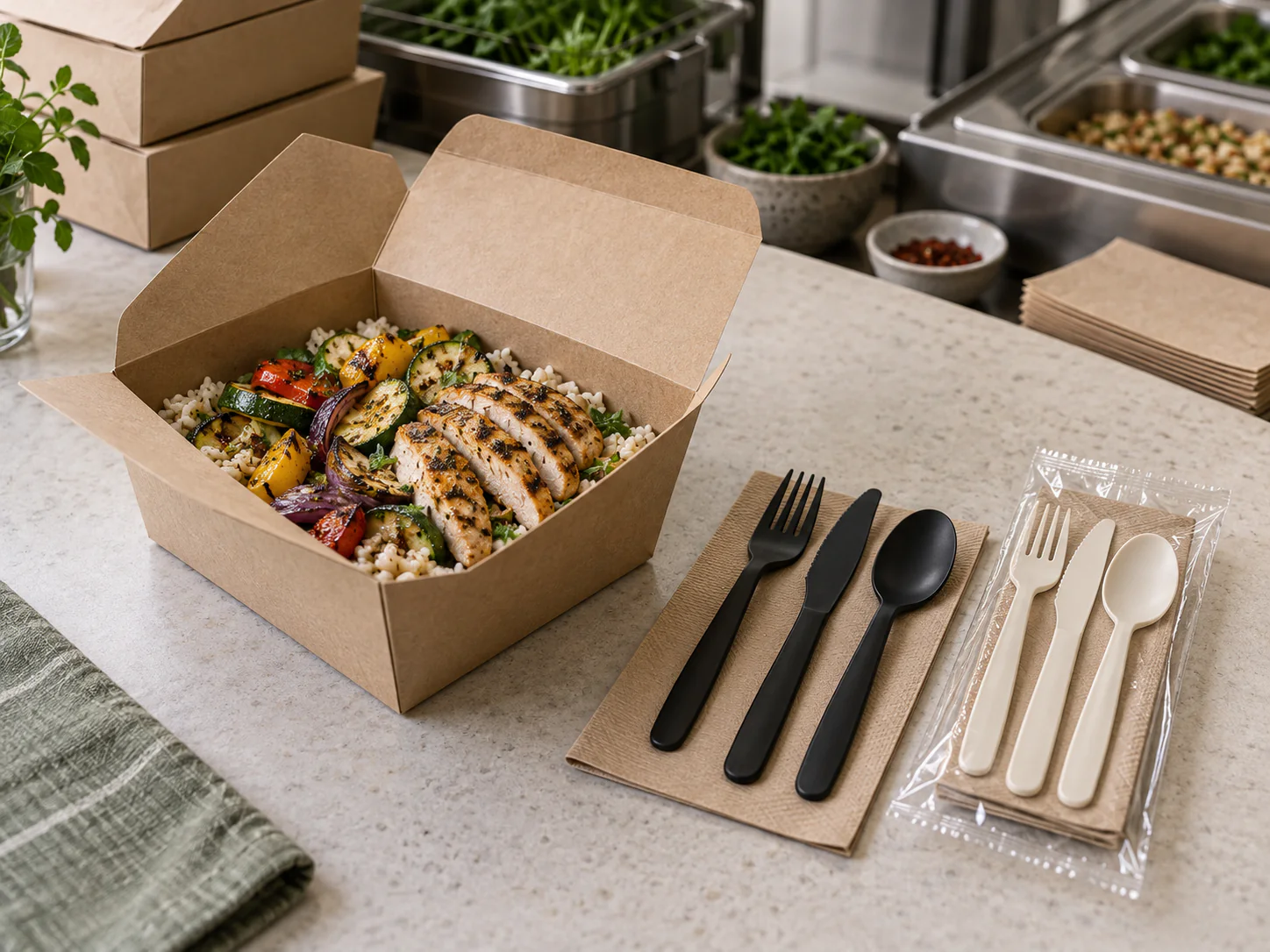
Map how utensils reach the customer.
Document where utensils are stored, who selects them, whether staff or customers handle the pieces and whether the order is assembled centrally or at the point of service.
Add delivery, airline tray, catering or takeaway steps that affect how the utensils must remain grouped and identifiable.
- Issue point
- Staff or self-service handling
- Central or store assembly
- Delivery or tray service
- Required components
Browse bulk, wrapped and kit formats
Specify bulk packing as a real configuration.
For bulk pieces, record the utensil model, material, colour, pieces per inner pack and case, and how staff will pick or assemble them. Include any inner-bag or dispenser requirement.
Calculate the labour and inventory effect of creating sets on site. Keep the fork, knife and spoon case quantities visible when their use rates differ.
Medium-weight bulk: Selected fork, knife, tea-spoon and soup-spoon entries list 1,000 pcs/case
Heavy-weight bulk: Current white and black bulk references list 1,000 pcs/case
Define every wrapped component.
State whether the wrapper contains one utensil or a complete kit. List film or paper preference, transparency, print, seal presentation, barcode or date-code needs and each inserted component.
Wrapper material, dimensions and seal performance are project fields to confirm; a photograph of a wrapped item does not define them.
Test the operating routine, not only appearance.
Run samples through receiving, storage, picking, tray or bag assembly, transport and customer opening. Record missing pieces, wrapper condition, ease of issue and any operational error.
Use the same menu and workflow when comparing options. Define the test and sample identity so the result can be repeated.
Plan sample and quality checks
Compare material and waste by complete service.
Count all utensils, wrappers, napkins and added components issued per meal. Separate measured material or pack quantities from unsupported environmental claims.
If sustainability information is required, request model- and component-specific evidence and review it against the destination market and the buyer's own program criteria.
Quote complete costs and order units.
Compare the bulk pieces, assembly work, wrapper, inserted components, inner packs, case quantities and usable sets. Ask whether MOQ applies per utensil, wrapper artwork or kit configuration.
Confirm the final format, packing, sample record, documents, quantities, price and shipment milestone before release.
Review meal-kit MOQ and packing · Build the RFQ
Questions before quotation
Is individually wrapped cutlery always more hygienic?
Do not make a universal claim from presentation alone. Review the exact wrapper, handling process, intended use and applicable evidence for the program.
Is bulk cutlery always cheaper?
Compare the complete service cost, including staff assembly, inventory, inner packing, unused components and order quantities—not only the utensil piece price.
Can the wrapper be custom printed?
Artwork and print options can be reviewed after the wrapper and kit configuration are defined. Confirm feasibility, proof route, MOQ, packing and final version in writing.
Continue your buying brief
Cutlery and meal kits · Disposable cutlery sets bulk guide · Custom wrapped meal kits