
Disposable tableware should be specified around the meal and operating routine, not a diameter or material name alone. Connect every portion and service condition to an exact plate, bowl or tray before comparing samples, packing and commercial terms.
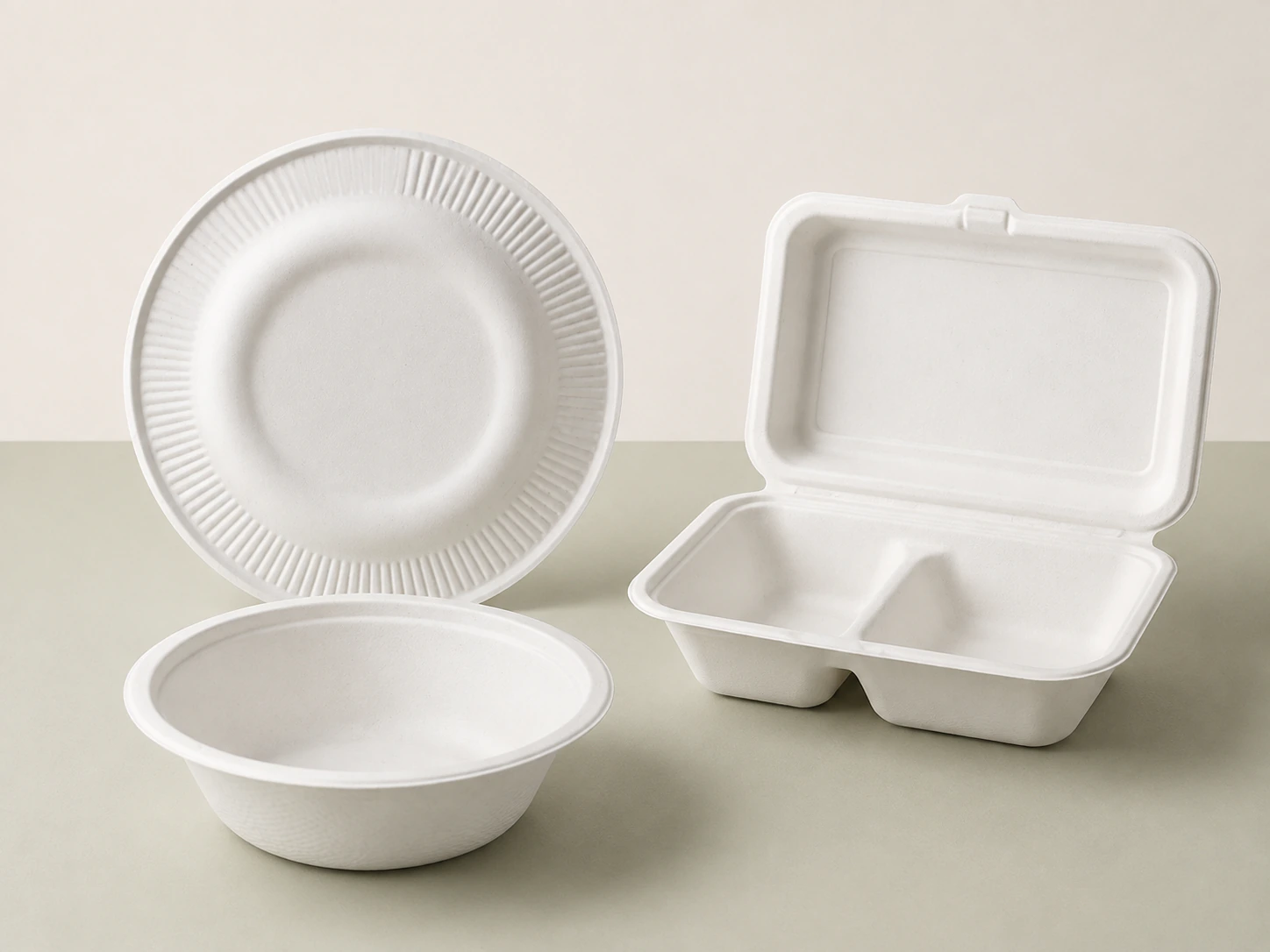
Map the meal before selecting the format.
List every food, target portion, sauce or liquid content, desired separation and presentation priority. State whether the service needs an open plate, a deeper bowl, a rectangular tray or a divided format.
Add filling, holding, carrying, stacking and customer-use conditions. These inputs create the service test for the exact model rather than relying on a broad material or category statement.
- Food and portion by component
- Fill and holding conditions
- Plate, bowl or tray
- Compartment allocation
- Carry and customer-use routine
Compare plates, bowls and trays
Compare the public range by exact model.
ANWELLUP currently lists four sugarcane bagasse bowl references, four bagasse plate references, four bagasse meal trays, four kraft paper bowls and eight mixed HIPS or PP tableware references. Keep the AW SKU with every dimension, sample and quotation line.
Examples include AW-BG-P10 and the divided AW-BG-P10C, plus 23 and 30 oz open bagasse trays and two three-compartment formats. Similar names do not make those models interchangeable.
Bagasse bowls: 4 listed models · 12–32 oz
Bagasse plates: 4 listed models · open and divided
Bagasse meal trays: 4 listed models · open and 3-section
Kraft paper bowls: 4 listed models · 500–2,000 ml
Review the food container size guide
Treat material as one field in a complete decision.
The current range includes sugarcane bagasse, kraft paper, HIPS and PP. Compare exact models through their measurable specification, intended food and service conditions, sample results and destination requirements.
For the mixed HIPS and PP family, the public table does not assign one material to each model. Keep that assignment open until it is confirmed in writing rather than inferring it from a photograph or size label.
Use the material comparison framework
Control compartments, lids and usable geometry.
Record diameter or capacity with footprint, height, rim and usable interior dimensions. For divided plates or trays, assign a food and portion to each section and note any food-separation requirement.
If a lid or film is required, identify it as a separate component. Confirm compatibility and packing, then test the exact filled system through closing, stacking, transport and opening.
Prepare the complete packaging RFQ
Approve samples under the real service routine.
Define whether a sample must prove portion fit, dimensions, food separation, stacking, carrying, closure, artwork layout or production finish. Record the model, components, test conditions and observations with the decision.
Do not turn a successful check on one model into a claim for the entire material family. Keep unresolved questions visible until the selected production specification and evidence are confirmed.
Compare MOQ, case packs and delivery on one basis.
State quantities per model and component and clarify whether they mean pieces, packs, cases or complete sets. A published case pack is not an MOQ; request the minimum and quoted quantity on the same line.
Ask for inner quantities, carton dimensions, gross weight, approval milestones, production trigger and shipment-ready date. Release the order only against the final specification, sample status, documents, packing and commercial terms in writing.
Understand packaging MOQ inputs
Questions before quotation
Which disposable tableware materials are listed?
The current range includes sugarcane bagasse, kraft paper and a mixed HIPS or PP family. Confirm the exact material, model and intended conditions before selection.
Can diameter or capacity alone identify the right format?
No. Add full dimensions, depth, usable area, rim, compartments, portion and any closure because nominal size does not define operational fit.
Is a listed case pack the minimum order quantity?
No. Case packing and MOQ are different fields. MOQ is confirmed for the exact model, components, customization, packing and destination.
What should a divided tray sample prove?
Use the intended meal to review portion allocation, separation, usable space, closure, stacking, transport and customer access with the exact model.
Continue your buying brief
Compare disposable plates, bowls and trays · Review food-container sizing · Build a complete packaging RFQ